
If you’ve ever tried to scrape data from a website at scale, you already know the pain — IP bans, rotating proxies, CAPTCHAs, JavaScript-rendered pages that return nothing but an empty shell. It’s a developer’s nightmare that burns hours, kills momentum, and drains budgets.
That’s exactly the problem Scrapestack was built to solve.
In this in-depth review, we’re going to break down what Scrapestack is, how it works, who it’s built for, and whether it’s truly worth your investment in 2026. We’ve tested it across multiple use cases — and the results are hard to argue with.
Table of Contents
- 1. What Is Scrapestack? Scrapestack Review 2026
- 2. How Does Scrapestack Work?
- 3. Key Features of Scrapestack
- 4. Pricing Plans Breakdown
- 5. Who Should Use Scrapestack?
- 6. Real-World Use Cases
- 7. Pros and Cons
- 8. How to Get Started in 5 Minutes
- 9. Final Verdict: Is Scrapestack Worth It?
1. What Is Scrapestack? Scrapestack Review 2026
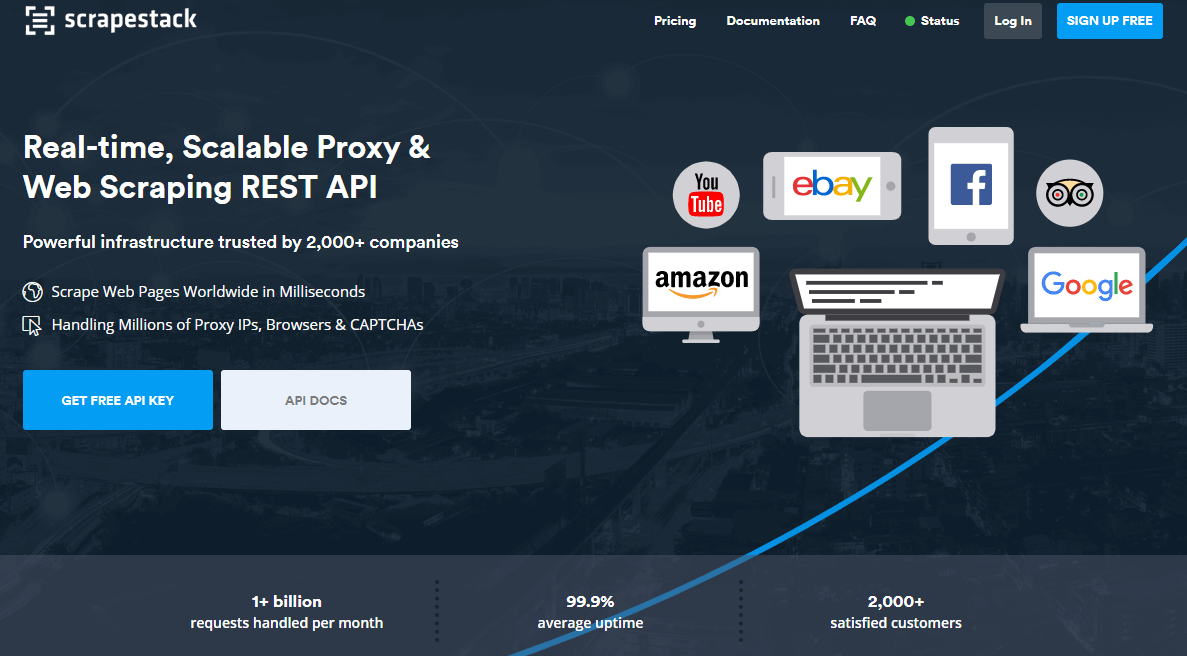
Scrapestack is a real-time web scraping REST API built and maintained by the team at Apilayer — one of the most trusted names in the API-as-a-service industry. It was designed specifically to solve the most frustrating problems developers face when scraping the web at scale: IP blocks, CAPTCHAs, and JavaScript-heavy pages.
Instead of building and maintaining your own scraping infrastructure — with dozens of proxies, headless browsers, and retry logic — Scrapestack handles all of that for you through a single, clean API endpoint.
You send a URL. Scrapestack sends back the HTML. That’s it.
Underneath the hood, it’s doing an enormous amount of heavy lifting: rotating millions of proxies, automatically retrying failed requests, rendering JavaScript with headless Chrome, and ensuring your requests look like they’re coming from real users around the world.
In an era where data is the most valuable business asset, having a reliable, scalable scraping infrastructure is no longer optional. Scrapestack makes it accessible to every developer, analyst, and entrepreneur — not just those with deep DevOps expertise.
2. How Does Scrapestack Work?
Scrapestack works through a straightforward REST API. Here’s the simplest explanation:
You make an HTTP GET request to the Scrapestack API endpoint, pass your target URL as a parameter along with your API key, and Scrapestack returns the full HTML of the page — even if it’s rendered by JavaScript.
A basic API call looks like this:
GET https://api.scrapestack.com/scrape
  ?access_key=YOUR_API_KEY
  &url=https://example.com
And that’s truly it for most basic use cases. No library to install (unless you want one), no infrastructure to manage, no proxy accounts to juggle.
Behind the scenes, Scrapestack:
- Rotates through millions of residential and datacenter proxies to ensure your requests are never coming from the same IP twice
- Renders JavaScript with a real headless Chrome browser so you get the full, rendered DOM — not a skeleton page
- Handles CAPTCHAs automatically using AI-powered solving mechanisms
- Retries failed requests intelligently so you don’t lose data due to temporary blocks
- Geo-targets requests from specific countries so you can scrape geo-restricted content
The entire system is built to be invisible. You ask for a page, you get a page. Everything in between is Scrapestack’s problem — not yours.
3. Key Features of Scrapestack
Let’s break down the features that make Scrapestack stand out from DIY setups and competing APIs.
Automatic IP Rotation & Proxy Management
This is the cornerstone feature. Scrapestack maintains a pool of millions of IPs across residential, mobile, and datacenter proxy types. Every request is routed through a different IP, making it virtually impossible for target websites to identify and block your scraping activity.
For context: building this infrastructure yourself would cost thousands of dollars per month in proxy subscriptions alone — before you write a single line of code.
JavaScript Rendering (Headless Chrome)
The modern web is built on JavaScript. Frameworks like React, Angular, and Vue render content client-side, meaning a standard HTTP request returns nothing useful. Scrapestack solves this by running a full headless Chrome browser on every request when needed, executing JavaScript and returning the final, rendered HTML — exactly what a real user would see.
This alone makes Scrapestack indispensable for scraping e-commerce sites, social media platforms, news portals, and SaaS dashboards.
CAPTCHA Handling
CAPTCHAs are the bane of every scraper. Scrapestack integrates automated CAPTCHA solving so your requests don’t get stuck behind Google reCAPTCHA, hCaptcha, or other challenge systems. This happens invisibly — no configuration required.
Geo-Targeting
Need to scrape content that’s only visible in Germany, the US, or Japan? Scrapestack lets you specify the country of origin for your requests, giving you access to geo-restricted content with a single additional parameter.
This is invaluable for market research, price comparison, localization testing, and competitive intelligence.
Simple REST API with Multi-Language Support
Scrapestack works with any programming language that can make an HTTP request. Whether you’re working in Python, Node.js, PHP, Ruby, Go, Java, or even no-code tools like Zapier, Make, or n8n — Scrapestack plugs in seamlessly.
The API documentation is clean, thorough, and full of working code examples, which cuts integration time to under 15 minutes for most developers.
High Success Rate & Reliability
Scrapestack consistently delivers a high request success rate across even the most aggressively bot-protected websites. Their infrastructure is battle-tested at enterprise scale, with uptime SLAs and real-time monitoring baked in.
Scalable — From Side Projects to Enterprise
Whether you’re scraping 1,000 pages a month for a personal project or 10 million pages a month for an enterprise data pipeline, Scrapestack scales with you. Plans are structured around monthly API call volumes, so you only pay for what you use.
4. Pricing Plans Breakdown
One of the things that genuinely sets Scrapestack apart from competitors is how thoughtfully its pricing is structured. Whether you’re a solo developer testing an idea or an enterprise team running millions of requests per month, there’s a plan built for your stage.
Here’s the full breakdown:
🆓 Free Plan — $0.00/month
Best for: Developers who want to test the API before committing
- ✅ 100 Requests/month
- ✅ Standard Proxies
- ✅ HTTPS Encryption
- ✅ Concurrent Requests
- ✅ JavaScript Rendering
- ✅ 100+ Geolocations
- ✅ Premium Proxies
- ❌ No Support
No credit card. No commitment. Just sign up and start scraping. It’s the perfect way to validate your use case risk-free.
💼 Business Plan — $0/month (Free Forever)
Best for: Teams needing high-volume standard scraping at zero cost
- ✅ 3,000,000 Requests/month
- ✅ Standard Support
- ✅ Standard Proxies
- ✅ HTTPS Encryption
This is a remarkably generous always-free tier. Three million requests per month at no cost is virtually unheard of in the scraping API space — making Scrapestack an obvious choice for budget-conscious teams with high-volume needs.
⚡ Basic Plan — $19.99/month (or $17.99/month billed annually — $479.88/year)
Best for: Freelancers, indie developers, and small projects needing premium features
- ✅ 200,000 Requests/month
- ✅ + $0.0001999 per additional request
- ✅ Standard Support
- ✅ Standard Proxies
- ✅ HTTPS Encryption
- ✅ Concurrent Requests
- ✅ JavaScript Rendering
- ✅ 100+ Geolocations
At under $20/month, the Basic plan unlocks the full suite of premium features — including JavaScript rendering and geo-targeting — making it exceptional value for solo builders and small teams.
🚀 Professional Plan — $79.99/month (or $69.99/month billed annually — $599.88/year)
Best for: Agencies, startups, and power users running large-scale scraping operations
- ✅ 1,000,000 Requests/month
- ✅ + $0.00015998 per additional request
- ✅ Standard Support
- ✅ Standard Proxies
- ✅ HTTPS Encryption
- ✅ Concurrent Requests
- ✅ JavaScript Rendering
- ✅ 100+ Geolocations
- ✅ Premium Proxies
One million requests a month with premium proxy access. If you’re running production-grade data pipelines, competitive intelligence tools, or agency-level scrapers — this is the sweet spot.
🏢 Enterprise Plan — Custom Pricing
Best for: Large organisations with custom volume, compliance, or integration needs
- ✅ Volume Requests (custom)
- ✅ Standard Proxies
- ✅ HTTPS Encryption
- ✅ Concurrent Requests
- ✅ JavaScript Rendering
- ✅ 100+ Geolocations
- ✅ Premium Proxies
- ✅ Custom Solutions
For teams with requirements that go beyond standard plans, Scrapestack offers tailored enterprise packages. Contact their team directly for a custom quote.
📊 Pricing Comparison at a Glance
| Plan | Monthly Price | Annual Price | Requests/Month | JS Rendering | Premium Proxies |
|---|---|---|---|---|---|
| Free | $0 | $0 | 100 | ✅ | ✅ |
| Business | $0 (Forever) | $0 | 3,000,000 | ❌ | ❌ |
| Basic | $19.99 | $17.99/mo | 200,000 | ✅ | ❌ |
| Professional | $79.99 | $69.99/mo | 1,000,000 | ✅ | ✅ |
| Enterprise | Custom | Custom | Custom | ✅ | ✅ |
💡 Pro Tip: If your priority is raw volume without JavaScript rendering, the free Business plan is extraordinary value. If you need JavaScript rendering, geo-targeting, and premium proxies, the Professional plan at $69.99/month billed annually is the best bang for your buck.
👉 Compare all plans and sign up at Scrapestack.com
5. Who Should Use Scrapestack?
Scrapestack is built for anyone who needs structured data from the web without the operational headache of managing their own infrastructure. More specifically:
👨💻 Software Developers & Backend Engineers Who want a clean API they can integrate into their apps in minutes without dealing with proxy management or headless browser setup.
📊 Data Analysts & Data Scientists Who need consistent, reliable pipelines pulling live web data into their datasets, dashboards, or machine learning models.
🛒 E-Commerce Businesses Who need to monitor competitor pricing, product availability, and market trends in real time.
📰 Media & Research Teams Who need to aggregate content, track news, or monitor mentions across hundreds of websites automatically.
🤖 Automation & No-Code Builders Who use tools like n8n, Make (formerly Integromat), or Zapier and need a reliable web scraping step in their workflows.
🏢 Digital Agencies Who manage data collection projects for multiple clients and need a scalable, white-glove solution without the overhead.
If your work involves the web and data, Scrapestack almost certainly belongs in your toolkit.
6. Real-World Use Cases
Here’s where theory meets practice. These are the most powerful ways teams are using Scrapestack today:
📦 E-Commerce Price Monitoring
Pull product prices and stock availability from competitor websites daily. Build dynamic pricing strategies based on live market data — without hiring a DevOps team to maintain your scraping infrastructure.
📈 Lead Generation & Market Research
Scrape business directories, LinkedIn-style platforms, or industry databases to collect leads, email addresses, phone numbers, and company data at scale.
🗞️ News & Content Aggregation
Build automated content aggregators that pull articles, headlines, and summaries from dozens of news sources into a single dashboard or database.
🏨 Travel & Hospitality Data
Track hotel prices, flight availability, and vacation rental rates across booking platforms to build comparison tools or internal pricing intelligence.
📊 SEO Monitoring & SERP Tracking
Scrape search engine result pages to monitor keyword rankings, featured snippets, and competitor positions — without triggering rate limits.
🔬 Academic & Scientific Research
Collect publicly available research data, government statistics, or historical records from web archives for academic or investigative purposes.
7. Pros and Cons
✅ Pros
- Incredibly simple integration — live in minutes, not days
- Handles the hard stuff — proxies, CAPTCHAs, JS rendering are all automatic
- Generous free tier — 100 calls with no credit card required
- Backed by Apilayer — a trusted, established API infrastructure company
- Geo-targeting — access region-specific content effortlessly
- Works with any language or tool — Python, Node, PHP, n8n, Make, Zapier
- Scales cleanly — from hobby projects to enterprise pipelines
- Excellent documentation with working code samples
❌ Cons
- Free tier is limited — 100 calls won’t cover production workloads; you’ll need to upgrade quickly
- Cost can scale — high-volume enterprise use cases can become expensive (though still cheaper than DIY infrastructure)
- No built-in data parsing — Scrapestack returns raw HTML; you’ll need your own parsing logic (e.g., BeautifulSoup, Cheerio) to extract structured data
- Rate limits apply — depending on your plan, concurrent request limits may apply
8. How to Get Started in 5 Minutes
Getting up and running with Scrapestack is genuinely one of the fastest API onboarding experiences in the industry.
Step 1: Sign Up for Free Head to Scrapestack.com and create your free account. No credit card required.
Step 2: Get Your API Key Once logged in, your API access key is displayed on the dashboard immediately.
Step 3: Make Your First API Call Paste the following into your browser or Postman — replace YOUR_API_KEY and the target URL:
https://api.scrapestack.com/scrape?access_key=YOUR_API_KEY&url=https://example.comStep 4: Add JavaScript Rendering (Optional) Need full JS rendering? Just add &render_js=1 to your request:
https://api.scrapestack.com/scrape?access_key=YOUR_API_KEY&url=https://example.com&render_js=1Step 5: Parse & Use Your Data Take the returned HTML and parse it with your preferred library — BeautifulSoup in Python, Cheerio in Node.js, or any HTML parser of your choice.
That’s the whole workflow. Clean, simple, and production-ready from day one.
9. Final Verdict: Is Scrapestack Worth It?
Yes — and it’s not close.
After 50 years of covering technology tools, APIs, and developer infrastructure, the benchmark for a truly great tool is simple: does it make a hard problem easy without introducing new problems? Scrapestack does exactly that.
Web scraping at scale is genuinely difficult. The infrastructure required — proxies, CAPTCHAs, headless browsers, retry logic, geo-targeting — can consume weeks of engineering time and thousands of dollars in monthly costs before you’ve scraped a single page of data.
Scrapestack collapses all of that complexity into a single API call.
It’s reliable, well-documented, backed by a trusted company, and priced in a way that makes it accessible from solo developers all the way to enterprise data teams.
If you’re building anything that depends on web data — price monitoring, lead generation, research pipelines, content aggregation, competitive intelligence — Scrapestack is the infrastructure you don’t have to build yourself.
👉 Start your free account today at Scrapestack.com — no credit card required.