
You cannot see it happening in real time. But it shows up everywhere — in the oversell apology emails your team dreads sending, in the stockout events that hand revenue directly to your competitors, in the working capital tied up in slow-moving stock you bought too much of because your forecasting was guesswork.
Table of Contents
- How We Evaluated These Apps
- The Top 10 Shopify Inventory Management Apps in 2026
- Side-by-Side Comparison
- A Critical Note for Shopify Plus Merchants
- What to Look for Beyond Features: 5 Questions to Ask Before Buying
- Conclusion: The Right Inventory App Is the One That Matches Your Complexity
Studies show that inventory inaccuracies cost retailers approximately 3.5% of annual revenue — and for a $5M Shopify store, that is $175,000 per year leaving through an invisible door.
The right inventory management app can close that door. Here are the ten best options for Shopify merchants in 2026, reviewed honestly and ranked by use case.
How We Evaluated These Apps
Each app was assessed on eight criteria:
- Real-time inventory sync accuracy
- Multi-location and multi-channel support
- Purchase order and supplier management
- Demand forecasting and replenishment alerts
- Shopify Plus and ERP compatibility
- Reporting and analytics quality
- Ease of use and onboarding experience
- Pricing value for the feature set delivered
The Top 10 Shopify Inventory Management Apps in 2026
#1 — Brightpearl
Best for: Mid-market Shopify and Shopify Plus merchants needing a full retail operations platform
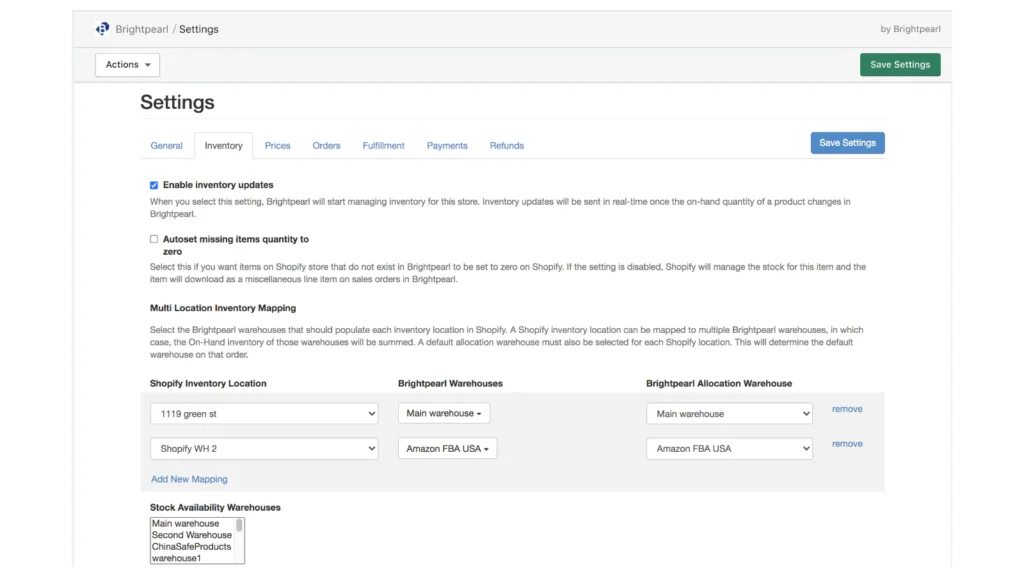
Brightpearl is less of an “app” and more of a retail operations platform that integrates deeply with Shopify. It combines inventory management, order management, warehouse management, financial reporting, and CRM into a single connected system — making it the closest thing to a lightweight ERP designed specifically for eCommerce.
Key Features:
- Real-time inventory sync across all channels (Shopify, Amazon, eBay, retail)
- Automated demand forecasting and replenishment workflows
- Built-in order routing and 3PL management
- Native Shopify and Shopify Plus connector (certified by Shopify)
- Warehouse management with pick-pack-ship workflows
- Financial reporting and profitability analysis by SKU, channel, and period
Best Fit: Shopify merchants doing $2M–$50M annually who want operational unity without a full ERP implementation
Pricing: From $375/month Shopify App Store Rating: 4.6/5 ERP Integration: Acts as an ERP alternative; also integrates with accounting systems
Pro Tip: Brightpearl’s automation engine (“Automation Rules”) can replace dozens of manual inventory management tasks — from triggering purchase orders at reorder points to routing orders to the optimal fulfillment location.
#2 — Cin7 Omni
Best for: Shopify merchants with complex inventory, multiple warehouses, and manufacturing or assembly requirements
Cin7 is a mature inventory and order management platform with one of the deepest feature sets in the market. Its native Shopify integration is robust and bidirectional, handling everything from product creation to inventory sync to order fulfillment.
Key Features:
- Multi-location inventory with granular location-level visibility
- B2B portal for wholesale order management
- Built-in EDI (Electronic Data Interchange) for large retail supplier relationships
- Manufacturing and assembly management (bill of materials)
- 700+ pre-built integrations including major ERPs
- Advanced reporting with custom dashboards
Best Fit: Growing Shopify merchants with complex supply chains, wholesale channels, or light manufacturing
Pricing: From $349/month Shopify App Store Rating: 4.3/5 ERP Integration: Strong — integrates with NetSuite, Xero, QuickBooks, Sage
#3 — Skubana (Now Extensiv Order Manager)
Best for: High-volume Shopify sellers operating across multiple channels and 3PLs
Extensiv (formerly Skubana) is purpose-built for high-volume, multi-channel sellers. If you are selling on Shopify, Amazon, Walmart, and through wholesale simultaneously, and managing multiple 3PL relationships, Extensiv brings order to the chaos.
Key Features:
- Automated order routing to optimal fulfillment center
- 3PL network management and rate shopping
- Real-time inventory across all channels and warehouses
- Profitability analytics by channel, SKU, and order
- Replenishment automation based on velocity and lead time
Best Fit: Shopify merchants doing 500+ orders per day across multiple channels
Pricing: Custom pricing from approximately $500/month Shopify App Store Rating: 4.4/5 ERP Integration: Compatible with major ERPs via API
#4 — DEAR Inventory (Now Cin7 Core)
Best for: Product businesses needing strong purchasing, costing, and accounting integration
DEAR Inventory rebranded as Cin7 Core following the Cin7 acquisition. It remains a strong choice for product businesses that need tight inventory-to-accounting integration, with robust support for landed costs, multi-currency purchasing, and bill of materials.
Key Features:
- Purchase order management with supplier tracking
- Landed cost calculation and allocation
- Production and assembly management
- Deep Xero and QuickBooks integration
- Serial number and batch/lot tracking
- Multi-currency purchasing
Best Fit: Product businesses with complex costing, manufacturing, or import/export operations
Pricing: From $349/month Shopify App Store Rating: 4.2/5
#5 — Linnworks
Best for: Multi-channel sellers who need a single source of truth across Shopify and all selling channels
Linnworks has long been the go-to platform for omnichannel sellers managing inventory across Shopify, Amazon, eBay, and dozens of other channels simultaneously. Its channel management breadth is unmatched.
Key Features:
- 100+ pre-built channel integrations
- Centralized inventory pool with channel-specific allocation rules
- Automated order routing and fulfillment
- Shipping carrier integration and rate optimization
- Robust reporting on channel profitability
Best Fit: Shopify merchants who are heavy marketplace sellers needing one inventory system to rule all channels
Pricing: From $449/month Shopify App Store Rating: 3.9/5 (note: lower rating reflects complexity of setup, not functionality)
#6 — Inventory Planner
Best for: Shopify merchants who want advanced demand forecasting without a full platform switch
Inventory Planner is the specialist’s choice — it does one thing and does it better than almost any other tool: it helps you buy the right amount of stock at the right time. Its forecasting algorithms account for seasonality, trends, promotions, and supplier lead times.
Key Features:
- AI-powered demand forecasting by SKU
- Automated replenishment recommendations
- Purchase order generation with supplier management
- Seasonal and promotion-adjusted forecasts
- Multi-location inventory planning
- Cash flow impact modeling for purchasing decisions
Best Fit: Shopify merchants losing money to either stockouts or overstock situations
Pricing: From $99.99/month Shopify App Store Rating: 4.7/5 Note: Works as an add-on to existing inventory systems — not a standalone operations platform
#7 — Stock Sync
Best for: Shopify merchants needing to sync inventory from suppliers, dropshippers, or multiple data sources
Stock Sync solves a very specific — and very common — pain point: keeping your Shopify inventory synchronized with external data sources like supplier feeds, dropship partners, CSV files, or third-party systems.
Key Features:
- 30+ feed types supported (CSV, XML, JSON, FTP, API)
- Automated scheduled syncs at custom intervals
- Price and quantity update automation
- Multi-location inventory support
- Dropship inventory management
Best Fit: Dropshippers, brands with multiple suppliers, or any Shopify merchant syncing inventory from external sources
Pricing: Free plan available; paid plans from $5/month Shopify App Store Rating: 4.6/5
#8 — ShipHero
Best for: Shopify brands building or scaling their own warehouse operations
ShipHero is both a warehouse management system (WMS) and a fulfillment network — meaning you can use their software to run your own warehouse, or use their physical fulfillment network, or both.
Key Features:
- Full-featured WMS with pick, pack, and ship workflows
- Barcode scanning and mobile picking support
- Batch picking for high-volume operations
- Real-time inventory visibility across all locations
- ShipHero fulfillment network access (30+ warehouses)
- Shopify native integration with real-time order sync
Best Fit: Shopify brands doing 500–50,000 orders per month who want to optimize their warehouse operations
Pricing: From $1,995/month for merchant WMS; fulfillment pricing based on volume Shopify App Store Rating: 4.2/5
#9 — Stocky by Shopify
Best for: Smaller Shopify merchants needing basic inventory management and purchase orders at no extra cost
Stocky is Shopify’s own free inventory management app — and for what it does, it does it well. It handles purchase orders, supplier management, demand forecasting, and inventory transfers between locations.
Key Features:
- Purchase order creation and management
- Demand forecasting with reorder suggestions
- Inventory transfers between Shopify locations
- Supplier management
- Low stock alerts
- Fully free for all Shopify merchants
Best Fit: Shopify merchants with straightforward inventory needs who want a free, native solution
Pricing: Free Shopify App Store Rating: 3.7/5 Limitation: Lacks the sophistication of paid solutions — not suitable for high-volume or multi-channel operations
#10 — Veeqo
Best for: UK and US-based Shopify merchants wanting multi-channel inventory with built-in shipping discounts
Veeqo (owned by Amazon) offers multi-channel inventory management with a unique value-add: deeply discounted shipping rates through carrier partnerships. For merchants where shipping cost is a significant margin concern, this can represent substantial savings.
Key Features:
- Multi-channel inventory sync (Shopify, Amazon, eBay, Etsy)
- Discounted rates with UPS, USPS, FedEx, DHL
- Warehouse management with barcode scanning
- Reporting on channel and SKU profitability
- Purchase order management
Pricing: Free (Veeqo is now free for all merchants) Shopify App Store Rating: 4.5/5 Note: Best value proposition for merchants where shipping cost savings offset any feature limitations vs. paid alternatives
Side-by-Side Comparison
| App | Best For | Price From | Multi-Location | Forecasting | ERP Compatible | Rating |
|---|---|---|---|---|---|---|
| Brightpearl | Mid-market all-in-one | $375/mo | ✅ | ✅ Advanced | ✅ | 4.6 |
| Cin7 Omni | Complex operations | $349/mo | ✅ | ✅ | ✅ | 4.3 |
| Extensiv | High-volume multi-channel | ~$500/mo | ✅ | ✅ | ✅ | 4.4 |
| Cin7 Core | Costing + accounting | $349/mo | ✅ | ✅ | ✅ | 4.2 |
| Linnworks | Omnichannel sellers | $449/mo | ✅ | ✅ | ✅ | 3.9 |
| Inventory Planner | Forecasting specialist | $99/mo | ✅ | ✅ Best-in-class | ✅ | 4.7 |
| Stock Sync | Supplier data sync | $5/mo | ✅ | ❌ | Limited | 4.6 |
| ShipHero | Warehouse operations | $1,995/mo | ✅ | ❌ | ✅ | 4.2 |
| Stocky | Basic free solution | Free | ✅ | Basic | ❌ | 3.7 |
| Veeqo | Shipping savings + sync | Free | ✅ | ❌ | Limited | 4.5 |
A Critical Note for Shopify Plus Merchants
If you are on Shopify Plus and considering a serious inventory management upgrade, you face a fork in the road:
Path A: Best-of-breed inventory app + ERP integration Choose a specialized inventory app (Brightpearl, Cin7, or Extensiv) and integrate it with your ERP system. This gives you maximum functionality but requires integration architecture to keep everything in sync.
Path B: Full ERP with native Shopify integration Implement a full ERP system (NetSuite, Dynamics 365, Odoo) with a native Shopify connector. The ERP handles inventory management natively, eliminating the need for a separate inventory app.
For merchants above $5M in revenue with an ERP already in place or planned, Path B is almost always the right answer. A properly integrated ERP delivers inventory management as part of a unified business system — not as a siloed tool.
Learn more: [Shopify ERP Integration: The Complete 2026 Guide →]
What to Look for Beyond Features: 5 Questions to Ask Before Buying
1. What happens to my data if I cancel? Can you export your complete inventory history, purchase orders, and supplier data? Data portability matters.
2. How does it handle variants and bundles? If you sell products with many variants or frequently bundle SKUs together, verify the app handles these natively before committing.
3. What is the implementation timeline and support model? A complex inventory platform can take weeks to properly configure. Understand the onboarding process before signing.
4. How does it handle negative inventory? Does the app allow negative inventory (selling stock you do not technically have yet)? Can you control this behavior by product?
5. Does it integrate with your 3PL? If you use a third-party logistics provider, verify the app has a native or certified integration before purchase.
Conclusion: The Right Inventory App Is the One That Matches Your Complexity
There is no universally “best” Shopify inventory management app. The right choice depends entirely on your order volume, channel complexity, product types, and operational maturity.
For early-stage stores: Start with Stocky (free) and add Inventory Planner when forecasting becomes critical.
For growing mid-market stores: Brightpearl or Cin7 Omni are the strongest all-around performers.
For high-volume multi-channel operations: Extensiv (Skubana) or Linnworks.
For Shopify Plus merchants with ERP plans: Evaluate whether a dedicated inventory app is still necessary once your ERP integration is in place.
The worst move you can make is to over-invest in inventory software that duplicates functionality you are already paying for — or to under-invest until operational chaos forces an emergency solution.
Choose deliberately. Implement properly. And revisit your stack annually as your business evolves.