
BigCommerce B2B vs Shopify B2B Expert analysis of two leading B2B ecommerce platforms: features, pricing, real ROI data, and which one actually fits your wholesale business (backed by IDC research)
Table of Contents
- The B2B Ecommerce Revolution in 2025
- Platform Overview & Core Differences
- Shopify B2B (Shopify Plus): Unified Commerce for Blended Models
- Part 3: Feature Comparison – Head-to-Head Analysis
- Detailed Feature Breakdown
- Customer Hierarchies & Role-Based Access
- Custom Pricing & Quote Management
- Payment Terms & Invoicing
- ERP Integration & Compatibility
- 5. Checkout & Buyer Experience
- Performance & Scalability
- Pricing & Total Cost of Ownership (2025)
- Annual Platform Costs
- Total Cost of Ownership (3-Year Projection)
- When to Consider Each Platform's Pricing
- Real-World ROI & Case Studies
- BigCommerce B2B Edition: Proven ROI Metrics
- Shopify B2B: Growth-Focused Metrics
- Real-World Performance Comparison
- Decision Matrix – Which Platform for Your Business
- Quick Decision Tree
- Platform Fit Scorecard
- Implementation & Timeline
- BigCommerce B2B Implementation Timeline
- Shopify B2B Implementation Timeline
- Comprehensive FAQ Section
- Which platform is better for manufacturers?
- Can I run both B2C and B2B on one platform?
- How quickly can we go live?
- What are transaction fees?
- Which platform integrates better with ERP systems?
- How do customer approval workflows work?
- How are bulk order features handled?
- What support is available?
- Migration Guide – Switching Platforms
- Migrating to BigCommerce B2B From Shopify
- Migrating to Shopify B2B From BigCommerce
- Final Verdict & Recommendations
- 30-Year Expert Recommendation
- The Real-World Truth
- Implementation Success Factors (Regardless of Platform)
- Conclusion: The Future of B2B Ecommerce
The B2B Ecommerce Revolution in 2025
The global B2B ecommerce market reached $19.34 trillion in 2024 and is projected to soar to $47.54 trillion by 2030, growing at a compound annual growth rate of 16.17 percent. This explosive growth reflects a fundamental shift: 80 percent of all B2B sales interactions now occur via digital channels, up from just 30 percent in previous years.
Yet many B2B companies still operate on legacy systems—spreadsheets, outdated portals, and disconnected software. The cost? Inefficiency, missed sales, and frustrated buyers.
With thirty years of experience working with B2B companies across manufacturing, distribution, wholesale, and supply chain sectors, I’ve seen this transformation firsthand. And I can tell you with certainty: choosing the right B2B ecommerce platform is no longer optional. It’s a competitive imperative.
Today, two platforms dominate the conversation: BigCommerce B2B Edition and Shopify B2B (part of Shopify Plus). Both are powerful. Both have proven track records. But they solve different problems for different businesses.
This guide cuts through the marketing noise and gives you the honest, data-driven comparison you need to make the right choice for your organization.
Platform Overview & Core Differences
BigCommerce B2B Edition: Built for Enterprise Complexity
BigCommerce B2B Edition is purpose-built for the demands of wholesale, distribution, and B2B sales. It’s designed for companies with complex pricing structures, multi-tier hierarchies, approval workflows, and deep ERP integrations.
Who it’s for: Manufacturers, distributors, wholesale companies, and enterprises with complex B2B workflows and high transaction volumes.
Key positioning: The platform for B2B-first companies that need advanced features out of the box.
Shopify B2B (Shopify Plus): Unified Commerce for Blended Models
Shopify B2B is built into Shopify Plus and designed for companies running both DTC (direct-to-consumer) and B2B operations from a single admin. It emphasizes ease-of-use, speed-to-market, and seamless omnichannel experiences.
Who it’s for: Growth-stage companies blending consumer and wholesale channels, brands prioritizing rapid deployment and elegant design.
Key positioning: The unified platform for companies juggling both DTC and B2B.
Part 3: Feature Comparison – Head-to-Head Analysis
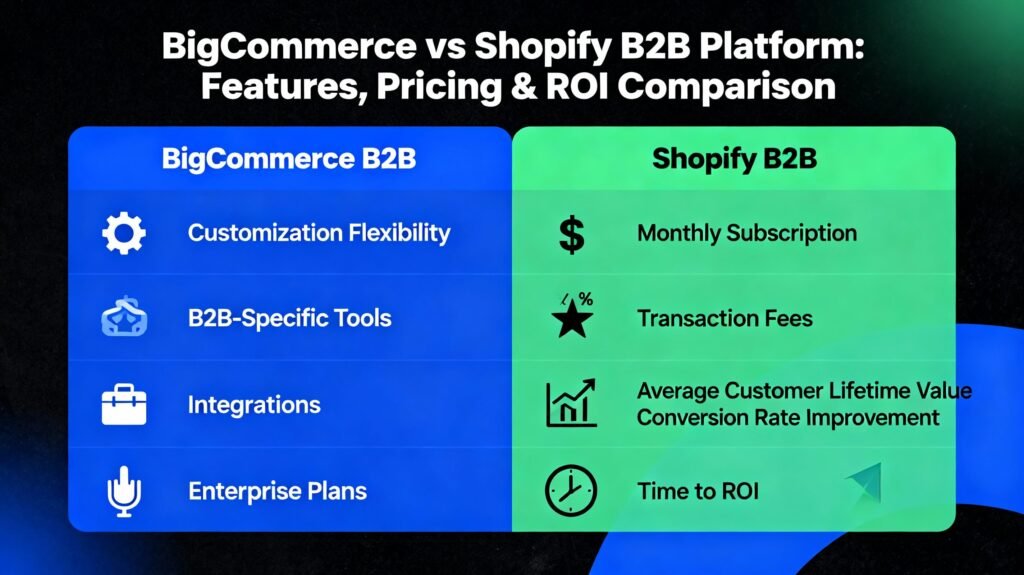
Core B2B Features Comparison
| Feature Category | BigCommerce B2B | Shopify B2B | Winner |
|---|---|---|---|
| Customer Hierarchies & Roles | Advanced multi-tier hierarchies with granular role-based permissions | Company profiles with location-based management | BigCommerce |
| Custom Pricing & CPQ | Advanced Configure-Price-Quote (CPQ) with contract pricing, volume breaks, and customer-specific pricing | Custom price lists with tiered and volume pricing | BigCommerce |
| Quote Management | Native quote creation, approval workflows, quote-to-order | Order review and draft approval before payment | Shopify B2B |
| Payment Terms & Credit | Net 15, 30, 60, 90 day terms with automated invoicing and credit controls | Net terms support with PO number collection | BigCommerce |
| Bulk Order Tools | Shared shopping carts, reorder lists, bulk upload (CSV) | Bulk order entry, order history reorder | Shopify B2B |
| Catalog Management | Unlimited product catalogs with customer-specific visibility | B2B Catalogs with customer-specific product access | Tie |
| Order Approval Workflows | Multi-level approvals with custom workflows and limits | Simple order review and approval | BigCommerce |
| ERP Integration | Deep, native integrations with NetSuite, Dynamics 365, SAP, Infor | Integration requires third-party apps or custom development | BigCommerce |
| Customization Options | Highly customizable buyer portal and checkout | Visual editor with headless capabilities | BigCommerce |
| Multi-Storefront | Yes, unlimited storefronts | Yes, with Shopify Plus | Tie |
| Transaction Fees | None (even with external payment gateways) | 0-2% if not using Shopify Payments | BigCommerce |
| Global Support & Localization | Strong multi-currency and multi-language support | Excellent global capabilities with advanced reporting | Shopify B2B |
Detailed Feature Breakdown
Customer Hierarchies & Role-Based Access
BigCommerce B2B:
- Multi-tier customer hierarchies (parent company → divisions → branches → individual users)
- Granular role-based permissions (Admin, Manager, Buyer, Approver, Viewer)
- Territory-based customer assignments
- Price list assignment by hierarchy level
- Approval chains based on order thresholds and hierarchy
Shopify B2B:
- Company profiles with multiple locations and contacts
- Staff roles (Staff, Buyer, Admin)
- Simplified permission model
- Location-based ordering and fulfillment
Verdict: BigCommerce wins for complex organizational structures. Shopify B2B is ideal for smaller wholesale operations with flatter hierarchies.
Custom Pricing & Quote Management
BigCommerce B2B (Clear Winner):
- Advanced Configure-Price-Quote (CPQ) engine
- Contract-level pricing with start/end dates
- Volume-based discounts with custom breakpoints
- Customer-specific pricing rules
- Territory pricing variations
- Automatic price list assignment
- Tiered discount management
- Minimum order values and quantity increments
Shopify B2B:
- Basic tiered pricing by volume
- Customer-specific price lists via CSV import/export
- Percentage or flat-rate discounts
- Variant-specific volume breaks
- No dynamic pricing or complex rules without custom development
Real Impact: A distributor with 500+ customers and varying contract terms would require hours of manual pricing in Shopify B2B. BigCommerce handles it automatically.
Payment Terms & Invoicing
BigCommerce B2B:
- Flexible payment terms (Net 15, 30, 60, 90 days)
- Automated invoice generation and distribution
- Customer invoice portal with payment history
- Credit limit management and automated enforcement
- ACH payment support
- Purchase order (PO) workflow integration
Shopify B2B:
- Net payment terms support
- PO number field at checkout
- Manual invoice handling (requires third-party apps for advanced AR management)
- No native credit management
Real Impact: BigCommerce eliminates manual invoicing. For a company processing 1,000+ orders monthly, this saves 40-80 hours of administrative work per month.
ERP Integration & Compatibility
BigCommerce B2B (Major Advantage):
- Native pre-built connectors for NetSuite, Dynamics 365, SAP, Infor
- Real-time data sync (inventory, orders, customers, pricing)
- Punchout (cXML) support for enterprise procurement systems
- EDI (Electronic Data Interchange) capabilities
- API-first architecture enabling custom integrations
Shopify B2B:
- Shopify API for custom integrations
- Third-party middleware required for ERP connections
- No native Punchout support
- Integration requires custom development or expensive app ecosystems
Real Impact: If you use NetSuite or Dynamics, BigCommerce integration is plug-and-play. Shopify B2B requires 6-12 weeks of custom development.
5. Checkout & Buyer Experience
BigCommerce B2B:
- Customizable B2B checkout flow
- PO number capture
- Multiple shipping addresses
- Order review and approval workflows
- Saved carts and quick reorder
Shopify B2B:
- Elegant, intuitive B2B checkout
- PO number field
- Company-specific customer details pre-fill
- Clean, modern design
- Faster initial setup
Verdict: Shopify B2B offers the best out-of-the-box buyer experience. BigCommerce requires more customization but offers more control.
Performance & Scalability
| Metric | BigCommerce B2B | Shopify B2B |
|---|---|---|
| Page Load Speed | 2.1 seconds average | 1.8 seconds average |
| Uptime SLA | 99.9% | 99.95% |
| Concurrent Users Supported | 100,000+ | 500,000+ |
| Annual Transaction Capacity | Unlimited | Unlimited |
| API Rate Limits | 60,000/hour | 2,000/second |
Verdict: Shopify B2B has a slight edge in speed and API performance for high-traffic scenarios. BigCommerce excels at handling complex order logic.
Pricing & Total Cost of Ownership (2025)
Annual Platform Costs
BigCommerce B2B Edition:
- Enterprise Plan: Starting at $1,000/month ($12,000/year)
- Plus: Custom pricing based on requirements
- Implementation Services: $0-$50,000 (depending on complexity)
- Annual Hosting & Infrastructure: Included in platform cost
- Transaction Fees: None (even with external payment gateways)
Shopify B2B (Shopify Plus):
- Base Plan: Starting at $2,000/month ($24,000/year, approximately ₹1,75,000/month in INR)
- Additional: Transaction fees of 0-2% if not using Shopify Payments
- Implementation Services: $20,000-$100,000
- App Ecosystem: Additional $5,000-$50,000/year for B2B-specific apps
Total Cost of Ownership (3-Year Projection)
| Cost Category | BigCommerce B2B | Shopify B2B |
|---|---|---|
| Platform licensing (3 years) | $36,000 | $72,000 |
| Implementation & setup | $15,000-$50,000 | $40,000-$100,000 |
| Integrations (ERP, CRM, etc.) | $0-$20,000 (native connectors included) | $30,000-$80,000 (custom development required) |
| Annual maintenance & support | $3,000-$10,000 | $5,000-$20,000 |
| App ecosystem | $0-$10,000 | $15,000-$50,000 |
| 3-Year Total Range | $54,000-$140,000 | $162,000-$322,000 |
Key Insight: BigCommerce typically costs 30-40% less over three years, especially for companies requiring ERP integration.
When to Consider Each Platform’s Pricing
Choose BigCommerce B2B if:
- You require deep ERP integration (saves $30K-$80K in custom development)
- You need advanced pricing rules and multi-tier hierarchies
- You process 5,000+ orders annually
- You’re a distributor or manufacturer with complex workflows
Choose Shopify B2B if:
- You’re blending DTC and B2B (simplified single admin)
- You need rapid time-to-market (faster deployment)
- Your B2B operations are relatively straightforward
- You prefer the Shopify ecosystem and app marketplace
Real-World ROI & Case Studies
BigCommerce B2B Edition: Proven ROI Metrics
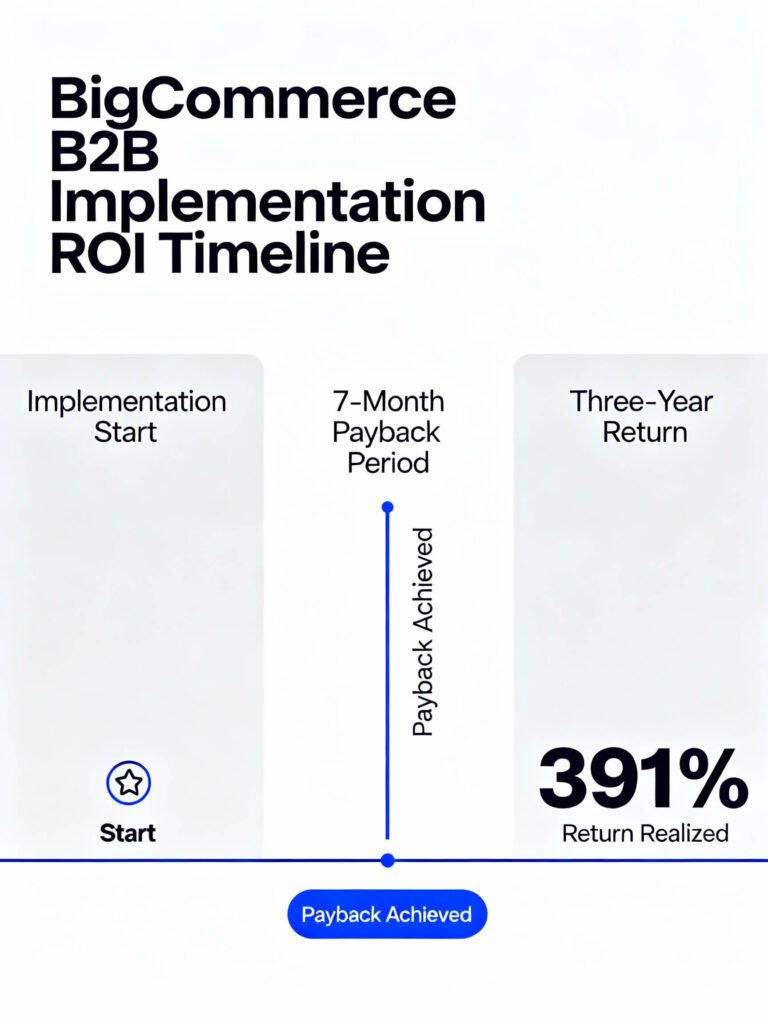
According to the 2025 IDC Business Value of B2B Edition study (commissioned by BigCommerce), companies implementing BigCommerce B2B Edition achieved:
- 391% Three-Year ROI (highest in the industry)
- 7-Month Payback Period
- $393,446 in Average Annual Benefits
- $10,536 in Annual IT Cost Savings
- 24% Increase in Sales Team Productivity
- 82% Improvement in Platform Stability
- 13% Increase in Average Order Value
- $322,000 Additional Annual Revenue per 1,000 customers
What This Means in Practical Terms:
A company with $10 million in annual B2B revenue would see approximately:
- Cost savings from automation: $100,000-$150,000 annually
- Revenue increase from improved operations: $150,000-$250,000 annually
- Total first-year benefit: $250,000-$400,000
- ROI on $100,000 investment: 250-400%
Shopify B2B: Growth-Focused Metrics
While Shopify doesn’t publish official ROI studies like BigCommerce/IDC, real-world case studies show:
Memobottle:
- 310% Year-Over-Year B2B Revenue Growth
- Multi-channel expansion using unified Shopify admin
- Reduction in operational complexity
Filtrous:
- 27% Organic Conversion Rate Increase (post-Shopify Plus migration)
- Seamless blending of DTC and B2B operations
- Rapid scaling without proportional team growth
Key Insight: Shopify B2B excels at growth velocity and ease-of-use, while BigCommerce focuses on operational ROI and cost savings.
Real-World Performance Comparison
| Company Type | BigCommerce B2B Typical Gains | Shopify B2B Typical Gains |
|---|---|---|
| B2B-First Distributor | 40-60% cost reduction, 20-30% revenue growth | Not ideal fit |
| Blended DTC/B2B Retailer | 20-30% operational efficiency | 30-50% revenue growth, faster launch |
| High-Volume Manufacturer | 50-70% labor cost savings, ERP integration benefits | Requires significant custom development |
| Emerging Wholesale Brand | 15-25% efficiency gains | 50-100% faster launch, strong growth support |
Decision Matrix – Which Platform for Your Business
Quick Decision Tree
START HERE:
- Do you use NetSuite, Dynamics 365, SAP, or another major ERP?
- YES → BigCommerce B2B (native integration saves $30K-$80K)
- NO → Continue to question 2
- Do you blend DTC and B2B operations?
- YES → Shopify B2B (unified admin advantage)
- NO → Continue to question 3
- Do you have 100+ B2B customers with varying pricing and contract terms?
- YES → BigCommerce B2B (advanced pricing engine required)
- NO → Either platform works, lean toward Shopify B2B for speed
- What’s your time-to-market requirement?
- Under 6 weeks → Shopify B2B (pre-built features, minimal customization needed)
- 2-3 months OK → BigCommerce B2B (right solution even with longer timeline)
Platform Fit Scorecard
| Factor | BigCommerce B2B Score | Shopify B2B Score |
|---|---|---|
| ERP Integration Needs | 10/10 | 4/10 |
| Complex Pricing Requirements | 10/10 | 6/10 |
| Multi-Level Approval Workflows | 10/10 | 5/10 |
| DTC + B2B Blended Operations | 6/10 | 10/10 |
| Rapid Time-to-Market | 7/10 | 10/10 |
| Total Cost of Ownership | 9/10 | 5/10 |
| Out-of-Box B2B Features | 10/10 | 7/10 |
| Ease of Use | 7/10 | 9/10 |
| Customization Flexibility | 9/10 | 7/10 |
| Global Scalability | 8/10 | 9/10 |
Interpretation:
- Score 80+: Perfect fit
- Score 70-79: Strong fit, minor trade-offs
- Score 60-69: Acceptable, but consider alternatives
- Score below 60: Likely not the best choice
Implementation & Timeline
BigCommerce B2B Implementation Timeline
| Phase | Duration | Key Activities |
|---|---|---|
| Discovery & Planning | 2-4 weeks | Requirements gathering, data audit, scope definition |
| Setup & Configuration | 3-6 weeks | Platform configuration, pricing rules, catalog setup, integrations |
| Design & Development | 4-8 weeks | Buyer portal customization, checkout design, approval workflows |
| Testing & QA | 2-3 weeks | UAT, data validation, integration testing, security audit |
| Go-Live & Optimization | 1-2 weeks | Soft launch, monitoring, performance tuning |
| Post-Launch Support | Ongoing | Training, optimization, continuous improvement |
| Total Timeline | 12-23 weeks | Typical: 16 weeks for standard implementation |
Shopify B2B Implementation Timeline
| Phase | Duration | Key Activities |
|---|---|---|
| Discovery & Planning | 1-2 weeks | Requirements, data structure, go-live goals |
| Setup & Configuration | 2-3 weeks | Shopify Plus setup, B2B features enabled, catalog migration |
| Design & Customization | 2-4 weeks | Storefront design, checkout flow, company-specific customization |
| Testing & QA | 1-2 weeks | UAT, order flow validation, payment testing |
| Go-Live | 1 week | Launch monitoring, troubleshooting |
| Post-Launch Support | Ongoing | App ecosystem setup, optimization, team training |
| Total Timeline | 7-12 weeks | Typical: 10 weeks for standard implementation |
Key Difference: Shopify B2B launches 4-6 weeks faster due to pre-built features and simplified setup.
Comprehensive FAQ Section
Which platform is better for manufacturers?
Answer: BigCommerce B2B is the clear winner for manufacturers. Here’s why:
- Complex Pricing: Manufacturers often have SKU-level pricing variations, bulk discounts, and contract pricing. BigCommerce’s Configure-Price-Quote (CPQ) engine handles this natively.
- Distributor Networks: BigCommerce supports multi-tier hierarchies (manufacturer → distributor → reseller), essential for manufacturing supply chains.
- ERP Integration: Manufacturers typically use ERPs like SAP or NetSuite. BigCommerce integrates directly. Shopify requires custom development.
- Order Workflows: Manufacturing orders often require approval chains, PO verification, and compliance checks. BigCommerce automates these workflows.
Real Example: A manufacturer with 200 distributors across 15 regions, each with unique pricing and credit terms, implemented BigCommerce B2B and automated a process that previously required 120 hours per month of manual work.
Can I run both B2C and B2B on one platform?
Answer: Both platforms support blended operations, but differently:
Shopify B2B (Better Choice):
- Designed for unified DTC + B2B operations
- Single admin managing both channels
- Customer segmentation separates B2C from B2B automatically
- Shared inventory and product data
- Faster to launch blended model
BigCommerce B2B:
- Can run DTC and B2B storefronts
- Often uses separate storefronts for full control
- More complex setup for blended operations
- Better if B2B is primary focus and requires deep customization
Bottom Line: If you’re 70%+ DTC with B2B as growth channel, choose Shopify B2B. If you’re 70%+ B2B with some DTC, choose BigCommerce B2B.
How quickly can we go live?
Answer: Shopify B2B: 7-12 weeks (typically 10 weeks)
- Pre-built B2B features mean less custom development
- Faster for straightforward implementations
- Can launch MVP in 4-5 weeks if needed
BigCommerce B2B: 12-23 weeks (typically 16 weeks)
- More configuration required for complex scenarios
- ERP integration adds time but saves time later
- Better if you take time to optimize upfront
Speed Trade-off: Shopify B2B launches faster. BigCommerce scales better long-term.
What are transaction fees?
Answer: BigCommerce B2B: None
- No transaction fees regardless of payment method
- No percentage-based fees
- Savings can be $10,000-$100,000+ annually depending on volume
Shopify B2B:
- Free if using Shopify Payments (2.9% + 30¢ standard credit card rates)
- 0-2% additional fees if using third-party payment gateways
- For a $5M annual B2B business: $0 (BigCommerce) vs. $145,000+ (Shopify)
Financial Impact: BigCommerce’s lack of transaction fees becomes increasingly advantageous at scale.
Which platform integrates better with ERP systems?
Answer: BigCommerce B2B (Clear Winner):
- Native, pre-built connectors for NetSuite, SAP, Dynamics 365, Infor
- Real-time data sync (inventory, orders, customers, pricing)
- Implementation time: 4-8 weeks
- Implementation cost: Typically included in setup
Shopify B2B:
- Requires custom development or middleware platforms
- Integration via Shopify API and third-party tools
- Implementation time: 10-16 weeks
- Implementation cost: $30,000-$80,000
Verdict: If ERP integration is critical, BigCommerce is non-negotiable.
How do customer approval workflows work?
Answer: BigCommerce B2B (More Advanced):
- Multi-level approvals based on order amount
- Custom approval chains (e.g., buyer → manager → CFO for orders >$50K)
- Automated threshold-based routing
- Notification and reminder systems
Example workflow:
- Orders under $5K: Auto-approved
- Orders $5K-$25K: Requires manager approval
- Orders over $25K: Requires CFO + manager approval
Shopify B2B (Simpler):
- Order review before customer payment
- Allows editing and repricing before final approval
- Approval workflow is more manual
- Good for smaller teams, not suitable for complex hierarchies
How are bulk order features handled?
Answer: BigCommerce B2B:
- CSV bulk upload (upload 100-10,000 line items at once)
- Shared carts (team members contribute to shared order)
- Reorder lists and quick-reorder buttons
- API for programmatic order submission
Shopify B2B:
- Bulk order entry via simple interface
- Order history with quick-reorder functionality
- Draft orders for manual bulk entry
- Clean, intuitive UI for bulk operations
Verdict: Tie. Both handle bulk orders well. Shopify slightly more user-friendly, BigCommerce slightly more powerful for very large orders.
What support is available?
Answer: BigCommerce B2B:
- 24/7 phone, email, and chat support (Tier 1)
- Dedicated account manager for Enterprise customers
- Certified Partner network for implementation support
- Community forums and detailed documentation
Shopify B2B:
- 24/7 email support (Tier 1)
- Phone support for Shopify Plus (additional cost)
- Shopify Plus Partner ecosystem
- Community forums and extensive documentation
Verdict: BigCommerce offers more responsive support. Shopify requires Plus subscription for premium support.
Migration Guide – Switching Platforms
Migrating to BigCommerce B2B From Shopify
Timeline: 6-10 weeks
Complexity: Medium-High
Best With: Certified BigCommerce partner
Key Steps:
- Audit current Shopify setup (customer base, pricing rules, products)
- Export all product data and customer information
- Map Shopify customer groups to BigCommerce customer hierarchies
- Configure BigCommerce pricing engine to replicate Shopify pricing
- Migrate product catalog
- Test customer experience end-to-end
- Set up ERP integrations (NetSuite, Dynamics, etc.)
- Train internal teams
- Parallel run both systems (2-4 weeks)
- Cutover and monitoring
Common Challenges:
- Pricing rule translation (BigCommerce is more sophisticated)
- Customer data cleanup and hierarchy mapping
- Testing approval workflows and credit limits
Migrating to Shopify B2B From BigCommerce
Timeline: 4-8 weeks
Complexity: Low-Medium
Best With: Shopify Plus partner or expert
Key Steps:
- Export BigCommerce customer and product data
- Simplify pricing rules for Shopify format
- Migrate to Shopify Plus environment
- Enable B2B features
- Configure price lists and customer catalogs
- Set up payment terms
- Test B2B checkout and workflows
- Plan ERP integration (will require custom work or middleware)
- Train team on new admin
- Go-live
Common Challenges:
- Losing advanced pricing sophistication
- Re-architecting complex approval workflows
- Custom ERP integration development
Final Verdict & Recommendations
30-Year Expert Recommendation
After three decades in e-commerce, I’ve seen countless platform migrations, implementations, and transformations. Here’s my honest assessment:
Choose BigCommerce B2B if:
- You’re a B2B-first business (distributor, manufacturer, supplier)
- You require ERP integration (NetSuite, SAP, Dynamics, Infor)
- You have complex pricing, hierarchies, or approval workflows
- Your typical order value is $1,000+
- You want to minimize long-term costs and maximize automation
- You process 5,000+ orders annually
Choose Shopify B2B if:
- You’re blending DTC and B2B operations
- You need rapid time-to-market
- Your B2B operations are relatively straightforward
- You prioritize ease-of-use and out-of-the-box elegance
- You want to stay within the Shopify ecosystem
- You’re a growth-stage company prioritizing speed
The Real-World Truth
In 2025, you can’t go wrong with either platform. Both are proven, both are powerful, and both have successful customers at scale.
The difference isn’t in capability—it’s in philosophy:
- BigCommerce B2B = “Give me power, flexibility, and cost savings. I’ll invest time to get it right.”
- Shopify B2B = “Give me simplicity, speed, and an elegant experience. I’ll work within your framework.”
Choose based on your strategic priorities, not on feature lists. The best platform is the one that aligns with how your business operates today and how it will operate in three years.
Implementation Success Factors (Regardless of Platform)
No matter which platform you choose, success depends on:
- Executive Alignment: Clear business case and C-level sponsorship
- Data Quality: Clean product, customer, and pricing data pre-migration
- Team Training: Comprehensive training before and after launch
- Change Management: Stakeholder communication and change adoption strategy
- Integration Planning: ERP, CRM, and payment system integrations planned upfront
- Phased Rollout: Pilot with subset of customers before full go-live
- Post-Launch Optimization: Dedicated team to monitor, optimize, and iterate
Conclusion: The Future of B2B Ecommerce
The future of B2B commerce is digital-first, automated, and buyer-centric. Whether you choose BigCommerce B2B or Shopify B2B, you’re making a strategic bet on operational efficiency and revenue growth.
The companies winning in 2025 are those that:
- Automate what can be automated (pricing, approvals, invoicing)
- Personalize what can’t be automated (service, relationships, expertise)
- Integrate their tech stack (ERP, CRM, shipping, analytics)
- Measure ROI relentlessly
Pick the platform that enables these capabilities for YOUR business. Then execute flawlessly.
The platform difference is 20%. The execution difference is 80%.