

Enterprise software implementations have long been plagued by issues such as budget overruns, missed deadlines, and excessive complexity. Organizations have struggled for decades with fragmented requirements, scope creep, and testing bottlenecks. Luzid, a Silicon Valley startup co-founded by Andrés D. Carranza Moreno and Matheus, is addressing these persistent challenges with an innovative solution. Their AI copilot, David, is designed to transform the deployment of ERP (Enterprise Resource Planning) and CRM (Customer Relationship Management) systems like SAP and Salesforce.
Table of Contents
In an exclusive interview with ERP News, Luzid’s CEO, Andrés Carranza, elaborates on how agentic AI can eliminate inefficiencies, accelerate project timelines, and align business needs with technological delivery in a way that benefits both system integrators and end customers.
ERP News Interview: Andrés Carranza, CEO of Luzid
Q: Enterprise software implementations have been notoriously challenging. What led you and your co-founder, Matheus, to address this problem?
Andrés: You’re absolutely right. According to Gartner, over 75% of software implementation projects exceed budget or timeline expectations. Many executives we’ve spoken with have shared that they’ve never seen an implementation completed on time.
Matheus and I met at Stanford, where we both developed strong AI research and engineering backgrounds. My own experience includes time as a researcher at NASA during high school and as the youngest quantitative trader at Two Sigma. Matheus, on the other hand, worked at Meta AI and was a founding engineer at Orby AI.
In 2023, while collaborating with companies like Google and Uber on AI agents for back-office automation, we encountered a significant challenge: the barrier wasn’t the AI models themselves, but rather the lack of well-defined business processes. Without the right context, no AI agent can make autonomous decisions. Each time we deployed an AI agent, we had to assemble a “consulting squad” to map processes before the agent could be effective.
This challenge mirrors the issues faced by system integrators and end customers during enterprise software implementations. The most difficult part is obtaining the right context from key business stakeholders and ensuring this information is well-documented. This is where we saw an opportunity to create a solution that could not only make software implementations faster and more efficient, but also provide a continuous foundation for companies to map and update their processes. This, in turn, would accelerate the adoption of new software, including AI agents, across the enterprise.
Q: Can you break down what “David” actually does? How is it different from existing automation tools?
Andrés: David is not just another automation tool—it’s a copilot for software implementations. While automation tools focus on specific tasks, David captures and structures the entire context of a project from start to finish.
David operates in three primary areas:
- Workshop Intelligence: David listens to workshop discussions, prompts consultants with best-practice questions in real-time, and ensures that no requirements or decisions are overlooked.
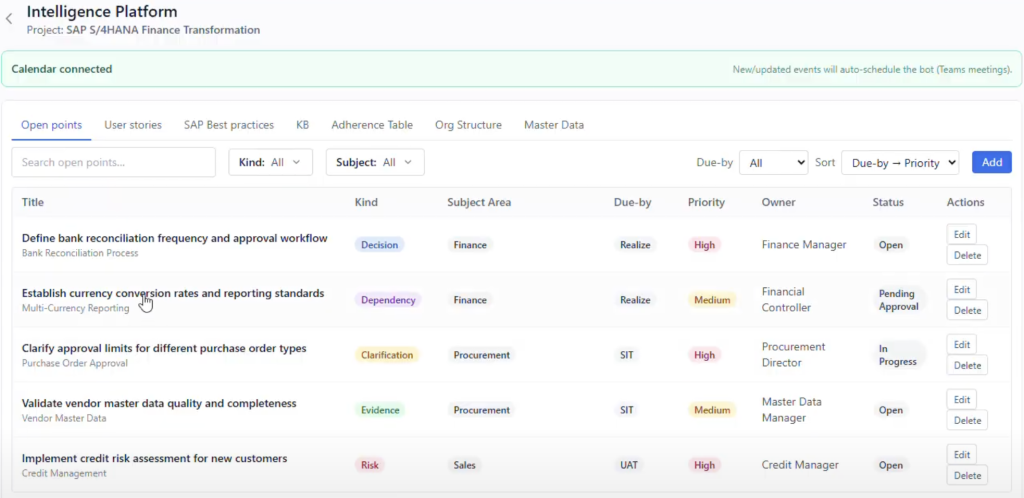
- Project Intelligence: David continuously monitors scope, change requests, and best practices, flagging issues before they turn into costly rework.
- Testing Intelligence: David automatically generates and maintains test scripts, manuals, and evidence, streamlining testing processes, reducing costs, and ensuring traceability.
Furthermore, David is tailored for specific software platforms. For SAP, David integrates seamlessly with the Activate methodology and Cloud ALM, functioning as a native SAP tool. For Salesforce, it integrates with Salesforce’s ALM lifecycle and DevOps Center, ensuring it aligns with established practices.
The key advantage here is that David adapts to the existing workflows of consultants, making adoption seamless without forcing them to adjust their habits.
Q: Can you provide real-world examples of the impact David has had with customers like Numen?
Andrés: With Numen and other customers, consultants using David have reported up to a 90% reduction in the time it takes to design business blueprints. Typically, these documents take weeks to compile because information is spread across workshop recordings, notes, and pre-sales materials. David consolidates all this information into a first draft instantly, creating a structured blueprint. Consultants can then refine it using a chatbot trained on the project’s own meetings and documents.
For Vivo Consulting, we saw significant time savings during the testing phase. David can reduce the time required to create test scripts by as much as 70%, which in turn shortens the overall testing cycle by one to two weeks—a substantial improvement in enterprise software projects, where testing is often one of the most significant bottlenecks.
Q: Why is testing such a major pain point in software implementations?
Andrés: There are three key challenges with software implementation testing:
- Deciding what to test: Every company has unique processes and customizations, making it inefficient to test everything.
- Automation tools often require heavy maintenance: Test data can break automation scripts, leading to diminishing returns.
- Gaps in requirements and handoffs: When requirements aren’t fully captured or handed off correctly, tests often miss crucial elements, resulting in rework and delays.
David addresses these issues by automatically generating test scripts based on user session recordings. Instead of consultants manually documenting every step of the process, David captures it in real-time and converts it into structured test scripts. This dramatically reduces the time and effort needed for test creation while ensuring the tests reflect how users actually interact with the system.
David also automates the analysis of test execution results. Traditionally, consultants would need to be present during testing to validate each step. With David, this validation happens in the background, with errors flagged and results logged automatically.
Finally, David cross-checks the requirements captured during discovery and design phases against the generated test scripts to ensure comprehensive coverage. This minimizes the risk of missing critical functionality during testing.
Q: How does David address the challenge of scope creep, which is often a major issue in software implementations?
Andrés: Scope creep is a pervasive challenge in enterprise software projects. It occurs when new requirements or change requests are introduced after the project has already started, often leading to delays, budget overruns, and a breakdown in trust between the client and the integrator.
David helps manage scope creep by automatically analyzing discussions after workshops and meetings to identify whether any of the topics discussed fall outside the original project scope. This provides consultants with an opportunity to address scope creep early on—whether by managing expectations, capturing change requests, or resetting priorities before they spiral out of control.
In addition, David offers best-practice recommendations based on the software vendor’s methodology (like SAP Activate) and insights from similar projects. This helps consultants proactively steer the project and avoid common pitfalls.
The result is more controlled delivery, fewer surprises, and a smoother path to successful project completion.
Q: Are there plans to expand beyond SAP and Salesforce?
Andrés: Absolutely. Our customers don’t just rely on SAP or Salesforce—they use a wide range of interconnected systems across various business functions, including finance, HR, and supply chain. We started with SAP and Salesforce because these platforms present the most complex implementations and affect multiple business processes.
However, the true challenge lies in the integration of systems. Every new system must work seamlessly with existing ones. Our long-term goal is to make David a universal copilot for all enterprise software implementations, ensuring that companies can track integrations and maintain consistent, up-to-date knowledge across projects, regardless of the platform. Whether it’s SAP, Salesforce, or another system, our mission is to make software implementation feel less like a daunting, one-off project and more like a seamless software update.
Q: What does success look like for Luzid?
Andrés: For us, success means transforming enterprise software implementations from cumbersome, “project-based” endeavors into simple, seamless software updates—something akin to updating your phone’s operating system. To achieve this, companies need their internal processes mapped, structured, and continuously updated. This requires a collaboration between AI and human expertise, where consultants still play a critical role in decision-making, but with AI facilitating and streamlining the process.
At Luzid, we are building the platform that will become the cornerstone of this new era in software implementation, empowering consulting teams and enterprises alike.
About Andrés D. Carranza
Co-founder & CEO, Luzid
Andrés Carranza is the co-founder and CEO of Luzid, where he drives product vision, strategic direction, and technological innovation. A Stanford dropout with a passion for accelerating global technology adoption, Andrés has conducted pioneering research in fields like mechanistic interpretability, time-series forecasting, and cross-domain model robustness. He has contributed to cutting-edge research at NASA, Harvard, MIT, and Two Sigma, where he became the youngest quantitative trader in the firm’s history. Andrés has presented his work at top-tier AI conferences such as ICML and ICLR, and was a finalist at the International Olympiad in Informatics (IOI).